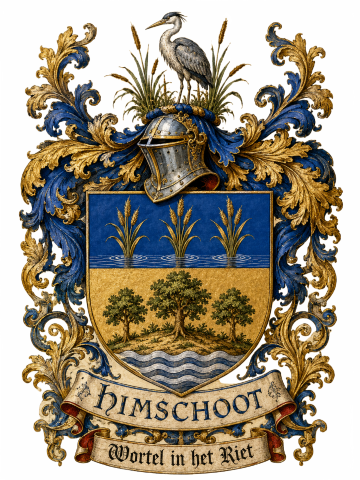
Himschoot family crest

Roots remembered. Stories shared.

This week in family history

17 Aug Angela Helena MORTIER b. 1911 in 3 days

Welcome to the Himschoot Family Tree — a private place to explore our shared heritage, family connections, and the stories that bind us across generations.

Access is available to family members by invitation. If you'd like access, please reach out to the site administrator.

The surname Himschoot is a topographic family name, meaning it was not inherited from an occupation or a personal nickname, but from a place — the spot of land where the first bearers of the name actually lived. According to Frans Debrabandere’s authoritative dictionary of Flemish family names, the root is a locality called Himschoot in Eksaarde, in the East Flemish province of Oost-Vlaanderen. Like many Flemish surnames, it crystallised during the late medieval period, when people began to be identified not just by their first name, but by where they came from.

The place name itself is a small window into the ancient landscape of the Meetjesland. The second element, “schoot,” derives from the Germanic word skauta, meaning a wooded corner of sandy soil rising out of a marshy environment — a little tree-covered nook jutting out of the surrounding wetlands. The first element, “him” or “im,” most likely traces back to the Middle Dutch word hin or hen, meaning sedge, the sharp-edged reed-like plant that carpets boggy ground. Put together, Himschoot meant something close to “the wooded corner where sedge grows” — a vivid, precise description of a patch of land in the flat, waterlogged Flemish countryside.

The family became deeply rooted in the hamlet of Balgerhoeke, on the border between Eeklo and Adegem, along the banks of the old Lieve canal. Local historical records describe the Himshoots as “een echte Balgerhoekse familie” — a true Balgerhoeke family — and their name appears repeatedly in land records from the 17th and 18th centuries: Jan van Himschoot in 1701, Pieter Himschoot fs. Adam in 1731, and a skipper named Pieter Himschoot in 1766, navigating the very waterways that had given his family its name generations before.

Today the name is remarkably rare. Only around 295 people in Belgium carry it, ranking it at number 5,694 among Belgian surnames, with 282 of those bearers living in Flanders. Variants such as Van Imschoot, Imschoot, Hemschoote and Vannienschoot all share the same root. It is a name that has changed little over the centuries, still pointing back to that same soggy, reed-filled corner of the Meetjesland where, a thousand years ago, someone decided to call it home.

De familienaam Himschoot is een topografische achternaam, wat betekent dat hij niet ontleend is aan een beroep of een bijnaam, maar aan een plek — de plek waar de eerste naamdragers daadwerkelijk woonden. Volgens het gezaghebbende woordenboek van Frans Debrabandere gaat de naam terug op een gehucht genaamd Himschoot in Eksaarde, in Oost-Vlaanderen. Zoals bij veel Vlaamse familienamen het geval is, ontstond de naam in de late middeleeuwen, toen mensen steeds vaker niet alleen bij hun voornaam werden aangeduid, maar ook bij hun herkomst.

De plaatsnaam zelf is een klein venster op het oude landschap van het Meetjesland. Het tweede lid, “schoot,” stamt af van het Germaanse woord skauta, dat een beboste hoek zandgrond in een moerasachtige omgeving aanduidt — een met bomen begroeid stukje land dat uitstak boven de omliggende natte gronden. Het eerste lid, “him” of “im,” gaat hoogstwaarschijnlijk terug op het Middelnederlandse woord hin of hen, wat zegge betekent: de scherpe, rietachtige plant die op moerassige bodems groeit. Samen betekende Himschoot zoiets als “de beboste hoek waar zegge groeit” — een trefzekere omschrijving van een stukje land in het vlakke, waterrijke Vlaamse landschap.

De familie sloeg stevige wortels in het gehucht Balgerhoeke, op de grens van Eeklo en Adegem, langs de oevers van de oude Lieve. Lokale historische bronnen omschrijven de Himshoots als “een echte Balgerhoekse familie,” en hun naam duikt herhaaldelijk op in landregisters uit de 17de en 18de eeuw: Jan van Himschoot in 1701, Pieter Himschoot fs. Adam in 1731, en een schipper met de naam Pieter Himschoot in 1766, die over dezelfde waterwegen voer die zijn familie generaties eerder haar naam hadden gegeven.

Vandaag is de naam opmerkelijk zeldzaam. Slechts ongeveer 295 mensen in België dragen hem, waarmee hij op de 5.694ste plaats staat in de rangschikking van Belgische familienamen — en 282 van die naamdragers wonen in Vlaanderen. Varianten zoals Van Imschoot, Imschoot, Hemschoote en Vannienschoot delen dezelfde oorsprong. Het is een naam die door de eeuwen heen nauwelijks veranderd is, en nog steeds verwijst naar datzelfde natte, met zegge begroeide hoekje van het Meetjesland, waar iemand er ooit voor koos om er thuis te zijn.

Private — Members Only

Family members → sign in

Are All Worldwide Himschoots Related?

With a surname as rare as Himschoot — carried by only around 295 people in Belgium today, ranking at number 5,694 in the national list of family names — the question almost answers itself. Yet it is worth examining properly, because the answer turns out to be not merely probable but very nearly certain, and the evidence leads to some remarkable corners of the world.

The key to understanding why lies in the nature of the name itself. Himschoot is a topographic surname: it does not describe an occupation, a personal trait, or a clan allegiance. It names a place — one specific, unremarkable patch of boggy, sedge-covered ground on the edge of the Meetjesland. A name like De Smet, meaning the blacksmith, could have been independently adopted by dozens of unrelated families across Flanders, because every village had a smith. But “the wooded corner where sedge grows” describes one location. One family, living on that land, took its name from it, and everyone who has carried the name since descends from them.

The earliest documented bearer of the name on genealogical record is Jan Himschoot, born in 1609 in Adegem and buried there in March 1667. He lived through the Thirty Years’ War in a region that knew occupation, plague, and disruption, yet the family endured. Throughout the seventeenth and eighteenth centuries, the Himshoots appear repeatedly in land and parish records around Balgerhoeke, the hamlet straddling the border of Eeklo and Adegem along the old Lieve canal, described by local historians as their home ground. From this small nucleus, all subsequent branches of the family appear to have grown.

The most compelling proof of a single worldwide origin comes from America. In or around 1880, a man named Peter Bernard Himschoot left Belgium with his wife Marie Theresa Vincent and crossed the Atlantic to settle in the American Midwest. The Belgian village he left behind was Sint-Margriete, a small community in the north of the Meetjesland, located in the arrondissement of Eeklo, no more than fifteen kilometres from Balgerhoeke. Sint-Margriete sits against the Dutch border, in the same flat, waterlogged landscape of polders and reed-fringed creeks that gave the Himschoot name its meaning. Peter and Marie settled eventually in the Willamette Valley of Oregon, part of a wider wave of Flemish Catholic emigrants who had been drawn to the American Midwest by the promise of affordable farmland. Their son, August Joseph Himschoot, was born on January 21, 1893 in Brooklyn, Iowa, and would live to the remarkable age of 98. The family put down deep roots: a stained-glass window at a local church was donated in the name of Peter Bernard Himschoot, a quiet but permanent marker of a Flemish family that had transplanted itself to the New World and thrived. The descendants of that emigration, many of them bearing the variant spelling Hemschoot, are today spread across Iowa, Oregon, Minnesota, and beyond — all tracing their line back to a man who once walked the same damp fields around Sint-Margriete that his ancestors had walked for generations before him.

The picture in South Africa is somewhat different. Current records show around twenty-three people bearing the Himschoot name there — a small but definite presence. Unlike the great Dutch emigration of the seventeenth century, which gave South Africa the foundations of Afrikaner culture, Belgian emigration to South Africa was never a mass historical movement. The Himschoots in South Africa are in all likelihood the product of more recent migration — the twentieth or twenty-first century rather than the nineteenth — driven by work, opportunity, or personal circumstance rather than any organised settler wave. There is no evidence of a separate or independent South African branch; every indicator points to Belgian origin, making the Meetjesland their ultimate point of departure as surely as it was for the branch that went to Iowa.

What ties all of these threads together is the arithmetic of rarity. A family name spoken by fewer than three hundred people in its country of origin, rooted in a single locality, documented in that locality since 1609, and traceable in every overseas branch back to the same narrow strip of East Flemish countryside — that is not a name with multiple independent origins. It is one family, dispersed by the ordinary forces of history: poverty, ambition, migration, and the endless human desire for a better life somewhere else. The sedge-covered corner of the Meetjesland that gave the Himschoots their name is a very small place. The family it produced has reached rather further than anyone living there in 1609 could ever have imagined.